Nasr City, 52 El Tayaran Street, in front of the Health Insurance Hospital

Treatment for a herniated disc in the lower back

What begins as mild lower back pain after routine daily effort can gradually escalate into a persistent discomfort that accompanies sitting, moving, or even sleeping. This often prompts the search for lumbar disc herniation treatment, raising key questions: Is this temporary discomfort that will resolve independently, or does it signal an underlying issue that could impair mobility and quality of life over time?
A herniated disc in the lumbar spine affects more than just the back; it can impair overall mobility, restrict daily activities, and radiate pain or numbness into the legs. Although disc herniation is often associated with mandatory surgery, non-surgical options—including pharmacological protocols, targeted physical therapy exercises, and modern interventions—effectively resolve many lumbar disc herniation cases.
This comprehensive medical guide outlines the nature of lumbar disc herniation, its clinical stages, diagnostic methods, and non-surgical treatment options designed to relieve pain and safely restore functional movement.
Lumbar Disc Herniation Treatment in Egypt: When Does Non-Surgical Treatment Begin?
A diagnosis of lumbar disc herniation does not dictate a single universal treatment plan. Clinical decisions depend on the degree of disc displacement, symptom severity, and the extent of nerve involvement or mobility impairment. In most cases, conservative management serves as the primary line of treatment to control pain, enhance functional mobility, and mitigate daily disruptions.
Non-surgical management of lumbar disc herniation is typically indicated in the following clinical scenarios:
-
Early to moderate stages of disc protrusion or herniation.
-
Absence of significant motor weakness or sensory deficits.
-
Pain levels that remain manageable and do not cause severe immobility.
-
Absence of acute spinal cord or severe neural compression.
-
Progressive symptom improvement over time with basic interventions.
-
Absence of high-risk neurological red flags requiring urgent surgical intervention.
At the clinic of Prof. Dr. Ahmed Ibrahim Salama—Consultant of Neurosurgery and Spine Surgery, Fellow of the Scoliosis Research Society (SRS) – USA, and Member of both the Egyptian and European Societies of Neurological Surgeons—treatment begins with a precise clinical evaluation. Assessing the degree of herniation and its neural impact allows for a tailored, minimal-intervention treatment strategy aimed at optimal recovery.
What Is Lumbar Disc Herniation and What Are Its Stages?
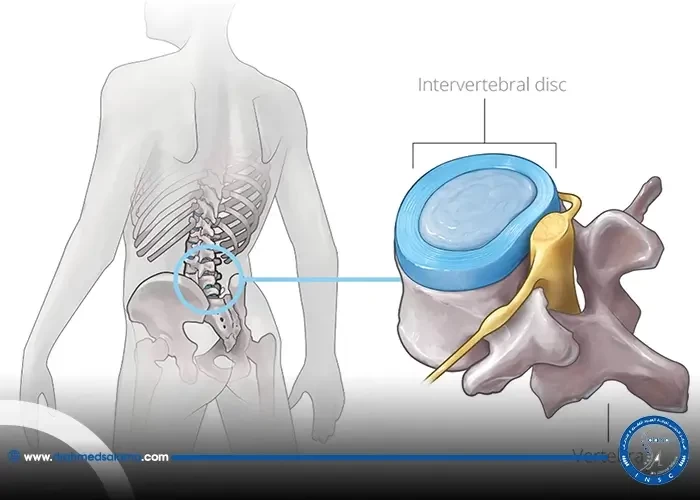
Lumbar disc herniation is among the most common structural spine disorders. It occurs when an intervertebral disc—functioning as a shock-absorbing cushion between lower back vertebrae—sustains damage or tearing, allowing its inner nucleus pulposus to displace beyond its normal anatomical boundary.
When displaced disc material compresses adjacent nerve roots, clinical symptoms emerge according to the degree and location of compression. Identifying the exact stage of herniation is crucial for establishing an effective therapeutic protocol.
Lumbar disc herniation is generally classified into three clinical stages:
-
Stage 1 (Disc Protrusion/Bulge): Mild disc bulge without complete tearing of the outer annulus fibrosus. Symptoms are typically localized and responsive to conservative management.
-
Stage 2 (Disc Extrusions): Partial tear of the annulus fibrosus with outward displacement of the nucleus pulposus. Nerve compression symptoms become more distinct.
-
Stage 3 (Disc Sequestration / Advanced Herniation): Significant herniation of disc content into the spinal canal, causing severe nerve compression and pronounced neurological symptoms.
Treatment decisions are guided by comprehensive diagnostics rather than pain intensity alone. A structured management plan helps relieve symptoms, prevent structural progression, and restore spinal mobility without long-term complications.
Symptoms of Lumbar Disc Herniation and Sciatica
The clinical presentation of lumbar disc herniation varies depending on the precise level of herniation and the degree of surrounding nerve involvement. Symptoms often begin subtly and progress if nerve root compression remains unmanaged. Key manifestations include:
Lower Back Pain Radiating to the Leg
Pain is the primary symptom of lumbar herniation, often originating above the buttocks and radiating down through the leg along the sciatic nerve distribution. For more details on differentiating general discomfort from nerve compression, review the Symptoms of a herniated disc in the back. This sharp or burning discomfort typically intensifies with prolonged sitting, coughing, sneezing, or sudden spinal movements.
Numbness and Muscle Weakness
Nerve compression may cause paresthesia (numbness or tingling) in the lower leg or foot. Motor fiber involvement can lead to localized muscle weakness, impairing walking, lifting, or performing routine physical movements.
Lower Back Stiffness and Mobility Restrictions
Patients frequently experience marked stiffness in the lumbar region, particularly in the morning or after prolonged rest. This restricts normal posture, making standing upright or bending uncomfortable.
Sensory Deficits in Lower Extremities
Sustained nerve compression can lead to diminished sensation across specific dermatomes of the leg or foot, resulting in a localized "numb" feeling that indicates significant nerve root involvement.
Involuntary Muscle Spasms
Irritation of spinal nerve roots frequently triggers painful, involuntary muscle spasms in the lower back or hamstrings, which can interfere with sleep and physical exertion.
Urinary Retention as an Emergency Warning Sign
In severe, advanced cases (such as Cauda Equina Syndrome), large disc herniations can compress nerve roots controlling bladder and bowel function. Symptoms like urinary retention or loss of sphincter control are critical emergency warning signs requiring immediate neurological intervention.
Persistent lower back pain radiating into the legs with associated numbness or motor weakness warrants early clinical evaluation. Timely diagnosis helps prevent disease progression and neurological deficits. Consult Prof. Dr. Ahmed Ibrahim Salama for a comprehensive spinal diagnostic workup.
Causes of Lumbar Disc Herniation and Risk Factors
Lumbar disc herniation develops gradually through age-related structural disc changes or acute excessive pressure on the lumbar spine. Daily habits and mechanical stress can accelerate symptom progression.
Primary causes and predisposing risk factors include:
-
Improper heavy lifting techniques involving spine twisting or awkward bending.
-
Age-related disc degeneration causing loss of hydration and elasticity.
-
Direct trauma, sports injuries, or fall-related impacts to the back.
-
Excess body weight placing continuous mechanical strain on lower lumbar vertebrae.
-
Occupational risks involving heavy manual labor, continuous vibration, or repetitive lifting.
-
Prolonged sitting with poor spinal posture.
-
Weak core and back muscles due to a sedentary lifestyle.
-
Genetic predisposition to early intervertebral disc degeneration.
-
Pregnancy, due to mechanical spinal load redistribution and hormonal ligament laxity.
Identifying these risk factors supports early diagnostic evaluation and timely therapeutic management, reducing pain and halting progression.
How Is Lumbar Disc Herniation Diagnosed?
Accurate diagnosis is a prerequisite before initiating treatment for lumbar disc herniation. Because lower back pain overlaps with various muscular and structural conditions, clinical diagnostic steps are required:
-
Medical History Review: Detailed assessment of symptom onset, pain distribution, mechanical triggers, and functional impact.
-
Neurological Examination: Assessment of motor strength, deep tendon reflexes, sensory deficits, and gait mechanics.
-
Provocative Maneuvers: Straight Leg Raise (SLR) test and positional maneuvers to assess spinal nerve root tension.
-
X-rays: Plain radiographs to rule out fractures, spondylolisthesis, or bony instability.
-
Magnetic Resonance Imaging (MRI): The gold standard diagnostic tool for visualizing soft tissue disc displacement, spinal canal stenosis, and nerve root compression.
-
Computed Tomography (CT) Scans: Utilized in select cases for detailed multi-planar osseous evaluation.
-
Electromyography (EMG) & Nerve Conduction Velocity (NCV): Diagnostic tests used to confirm nerve root dysfunction and locate the exact neural level.
At the center of Prof. Dr. Ahmed Ibrahim Salama, state-of-the-art diagnostic imaging and clinical testing guide personalized treatment planning.
Non-Surgical Treatment Options for Lumbar Disc Herniation
Advances in spine care allow non-surgical management to successfully treat a significant proportion of lumbar disc herniation cases, particularly when diagnosed early without progressive motor deficits.
Non-surgical protocols include:
Pharmacological Therapy
Medication aims to alleviate acute pain, reduce perineural inflammation, and control neuropathic symptoms:
-
Analgesics: Acetaminophen for basic pain control.
-
NSAIDs: Ibuprofen or equivalent agents to suppress nerve root swelling and inflammation.
-
Muscle Relaxants: Prescribed short-term to manage reactive muscular spasms.
-
Neuropathic Agents: Gabapentin or Pregabalin to modulate nerve pain and radicular paresthesia.
Note: All medications require professional medical supervision to optimize dosage and prevent side effects.
Physical Therapy and Exercise
Targeted physical therapy stabilizes the core, reduces intervertebral pressure, and restores spinal flexibility:
-
Stretching and core-strengthening exercises.
-
Low-impact aerobic activity like regular walking.
-
Modalities such as therapeutic ultrasound or electrical muscle stimulation.
Targeted Injections and Radiofrequency Ablation
When symptoms persist despite physical therapy and oral medications, minimally invasive interventions can provide relief:
-
Epidural Steroid Injections (ESI): Target fluoroscopy-guided corticosteroid injections to decrease localized nerve root inflammation.
-
Pulsed Radiofrequency (PRF): Interventional technique disrupting pain signal transmission along inflamed spinal nerves.
Adhering to structured conservative protocols resolves symptoms and restores functional activity in most patients.
When Does Lumbar Disc Herniation Require Surgery?
Surgical intervention for lumbar disc herniation is indicated when conservative measures fail to provide adequate relief, or when progressive neurological deficits threaten permanent dysfunction.
Indications for surgical evaluation include:
-
Unremitting, severe pain unresponsive to conservative medical therapy.
-
Progressive motor weakness, such as foot drop or severe leg instability.
-
Significant functional impairment affecting basic daily activities and standing capacity.
-
Continuous radicular pain radiating into the lower extremities.
-
Acute Cauda Equina Syndrome presenting with urinary retention or bowel dysfunction.
Surgical procedures—such as microscopic discectomy, endoscopic decompression, or Cartilage removal and stabilization of vertebrae—aim to relieve mechanical nerve root compression.
Patients undergoing surgical procedures can review How long does it take to recover from a spinal fusion surgery? for timeline expectations, while those considering specialized spinal deformity corrections may evaluate the Cost of scoliosis surgery in Egypt.
Factors Influencing Treatment Duration and Cost
Treatment timeline and overall cost vary depending on clinical complexity. Key determinants include:
-
Severity of disc displacement and structural nerve compression.
-
Symptom intensity and presence of neurological deficits.
-
Modality selected (pharmacological, physical therapy, interventional injections, or surgery).
-
Timing of initial clinical presentation.
-
Patient response to non-surgical conservative care.
-
Presence of underlying systemic conditions affecting recovery.
-
Surgeon expertise and surgical technology utilized.
Thorough clinical evaluation ensures a cost-effective, clinically sound plan tailored to individual patient needs.
Post-Treatment Guidelines to Prevent Recurrence
Long-term management focuses on protecting the lumbar spine and preventing recurrent disc herniation:
-
Perform core-strengthening and back exercises regularly.
-
Avoid prolonged sitting; take frequent movement breaks.
-
Maintain a healthy body weight to reduce mechanical load on lower lumbar vertebrae.
-
Use proper ergonomic lifting mechanics (bending at the knees, not the back).
-
Sleep on a supportive mattress maintaining natural spinal alignment.
-
Engage in daily low-impact exercise, such as walking.
-
Avoid sudden twisting movements under heavy physical loads.
Adhering to these preventive habits supports spine stability and reduces the risk of recurrent episodes.
Consult Prof. Dr. Ahmed Ibrahim Salama for Lumbar Disc Care
At the center of Prof. Dr. Ahmed Ibrahim Salama—Consultant of Neurosurgery and Spine Surgery, Fellow of the Scoliosis Research Society (SRS) – USA, and Member of both the Egyptian and European Societies of Neurological Surgeons—we deliver expert spinal diagnostics and evidence-based non-surgical and surgical care for lumbar disc disorders.
Our center offers:
-
Specialized expertise in complex neurosurgical and spinal procedures.
-
Comprehensive clinical assessment utilizing modern radiological and electrodiagnostic testing.
-
Individualized care plans prioritized around non-surgical management whenever clinically appropriate.
-
Surgical expertise in micro-decompression procedures when surgical intervention is indicated.
-
Dedicated post-treatment rehabilitation and follow-up care.
Schedule an evaluation today to establish an effective, safe treatment plan for lumbar disc relief.